
Quick Comparison at a Glance
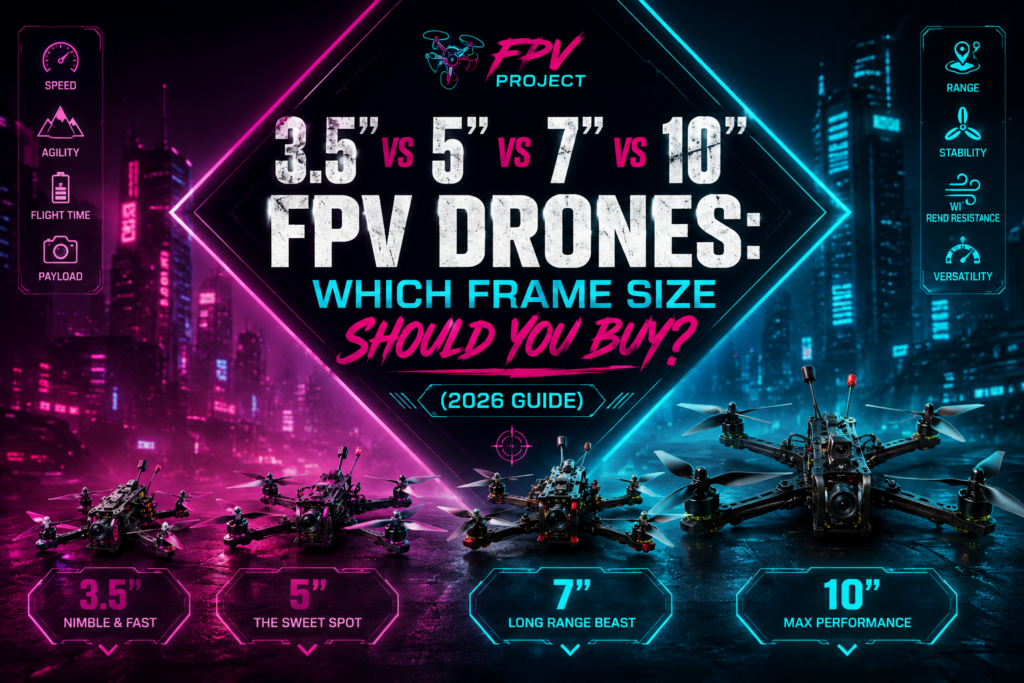
If you only remember one line from this guide, make it this: tight spaces and safety → 3.5″, all-round freestyle → 5″, cinematic power → 7″, long range → 10″. Now let’s break down why.
Frame size is the single most important decision in any FPV build. It determines your motor choice, prop size, battery weight, flight time, and even where you can safely fly. Pick the wrong size and you’ll either outgrow your drone in a month or struggle to fly it where you actually want to. Here’s how the four most popular sizes compare.
3.5″ Cinewhoop — Best for Tight Spaces & Safe Flying
The 3.5″ cinewhoop is built around one idea: fly close to people and objects without anyone getting hurt. Ducted props act as built-in prop guards, so a clipped wall or an accidental brush against someone’s arm doesn’t end in blood or a broken frame.
That safety margin comes with trade-offs. Ducts add drag, which means lower top speed and shorter flight times — typically 3 to 4 minutes per pack. But for the right use case, that’s a fair exchange.
Ideal for: indoor flying, narrow urban gaps, filming friends or events up close, and beginners who want to build confidence without the fear of a bare prop near skin.
Browse our 3.5″ Frame collection to get started.
5″ — The Industry Standard Freestyle/Racing Size
If you ask ten experienced FPV pilots what frame to learn on, most will say 5″. It’s the size the entire ecosystem is built around — the widest selection of frames, motors, props, and spare parts, and almost every tutorial, tuning guide, and Betaflight preset online assumes a 5″ setup.
It also happens to sit at a sweet spot of power-to-weight ratio. You get genuine freestyle agility and racing speed without the bulk of a 7″ or the fragility of a smaller whoop. Flight time typically runs 5 to 7 minutes, and because parts are everywhere, repairs are cheaper and faster than any other size on this list.
Ideal for: most pilots — freestyle, racing, and as the size to actually learn the fundamentals of building, tuning, and crashing (because you will crash) without burning through your budget.
Browse our 5″ Frame collection and 5″ Framekit Motors.
7″ — Cinematic Smoothness & Extra Punch
Step up to 7″ and the bigger props start doing something a 5″ simply can’t: smoothing out footage. Larger props move more air per rotation, which translates to steadier, more cinematic flight — exactly why 7″ builds are the go-to choice for pilots mounting action cameras or lightweight gimbals.
The extra lift capacity also means a 7″ can comfortably carry payload that would weigh a 5″ down. The cost is size and weight — a 7″ build is noticeably heavier, pricier to put together, and less nimble through tight gaps than its smaller sibling.
Ideal for: cinematic freestyle, action camera and gimbal payloads, and pilots who’ve outgrown 5″ and want more presence in the air without going full long-range.
Browse our 7″ Frame collection and 7″ Framekit Motors.
10″ — Long Range & Maximum Flight Time
10″ frames exist for one purpose: distance. These builds are almost always paired with GPS modules and ArduPilot or iNav firmware for long-range navigation, return-to-home safety, and stable cruise flight over kilometers rather than meters.
Flight time is where 10″ pulls dramatically ahead — 10 to 20+ minutes per pack depending on battery setup and how efficiently the build is tuned. That endurance is what makes long-range exploration and mapping missions possible in the first place.
Ideal for: long-range exploration, mapping, and any mission where maximum airtime matters more than agility.
Browse our 10″ Frame collection, 10″ Framekit Motors, and pair your build with a GPS Module for reliable long-range navigation.
How to Decide — 3 Questions to Ask Yourself
- Where will you fly most? Indoor or tight urban spaces point to 3.5″. Open fields point to 5″ or 7″. Genuine long-distance flying points to 10″.
- What’s your budget for crashes while learning? 5″ parts are cheapest and easiest to find — a real factor when you’re still building muscle memory.
- What are you actually flying for? Racing and freestyle fundamentals → 5″. Cinematic footage → 7″. Range and endurance → 10″. Safety around people → 3.5″.
Not Sure Which Size Is Right for You?
If you’re still on the fence, you don’t have to figure it out alone. We build, repair, and tune all four frame sizes daily, and our FPV training program walks you through the fundamentals on the size that fits your goals. Get in touch and we’ll help you choose.
Frame size is the foundation everything else is built on — get it right, and the rest of your build falls into place. Browse our full Frames collection to get started.